


Why choose APU?


Accreditation
More Than Just An International Business Management Degree

Upon completion of one of the above degree(s), you will gain added advantage with a Certificate of Participation in the SAP University Alliances.
Learn MoreRequirements
Entry Requirements
- 2 Passes in STPM with a minimum Grade C (GP 2.0) and a Pass in English and Mathematics at SPM Level or its equivalent.
- 2 Passes (Grade A-D) in A-Level with a Pass in English and Mathematics at SPM/ O-Level/ IGCSE or its equivalent.
- 5 Grade B’s in UEC with a Pass in Mathematics and English.
- Passed Foundation programme (minimum CGPA of 2.0).
- Successful completion of the APU Diploma or
- Successful completion of studies in another recognised institute with academic credits equivalent to Level 1 of an Honours Degree
Note: The above entry requirements may differ for specific programmes based on the latest programme standards published by Malaysian Qualifications Agency (MQA). The qualification and entry requirements for the programmes will be determined based on the "Comparison List of Equivalency of International Qualifications with SPM (O-Levels equivalent) and STPM (A-Levels equivalent)" published by Malaysian Qualifications Agency (MQA).
- IELTS : 5.5
- TOEFL IBT : 3.5
- Pearson (PTE) : 51
- MUET : Band 4
For more information please click HERE
What We Teach
This programme is specifically designed to provide students with:
- An understanding of the context, nature, role, and significance of management activities, with particular emphasis on global supply chains, logistics, and international business operations.
- An opportunity to develop well-researched, logical, and integrated solutions to complex, multi-faceted problems in dynamic international and supply chain contexts.
- Vocationally relevant exposure enabling students to manage global sourcing, procurement, and logistics processes effectively, enhancing operational performance across international markets.
- A wide range of employment skills including critical thinking, problem solving, communication, IT application, analytical reasoning, and the ability to conduct research in international business and supply chain management.
-
Degree Level 1
Students build a solid foundation in how businesses operate locally and globally. They gain essential skills in communication, quantitative analysis, people management, marketing, economics, and entrepreneurship. This year develops critical thinking, independent learning, and an understanding of core business functions. For students choosing the Supply Chain Management specialism, this grounding prepares them to appreciate how different business areas connect to form efficient supply networks. The broad first-year curriculum ensures they are well equipped before progressing into specialised supply chain subjects.
Common Modules
- Digital Thinking and Innovation
- Quantitative Skills
- Business and Communications Skills
- People Management
- Business Economics
- Fundamentals of Accounting
- Marketing
- Business Law
- Fundamentals of Entrepreneurship
Specialised Module
- Introduction to Management
-
Degree Level 2
Level 2 deepens students’ understanding of how organisations function across borders, exploring international culture, communication, operations, and business research. Students also begin to understand how global value chains operate through specialised elective modules related to supply chain and logistics. These electives help them link business processes to the movement of goods, procurement decisions, and supplier relationships. This stage strengthens their analytical and decision-making abilities while preparing them for more advanced supply chain concepts that support international business operations.
Common Modules
- Behavioural Science in Organisations
- Digital Marketing
- Innovation Process
- Business Research Methods
- Delivering Customer Value
- Managing Finance
Specialised Modules
- Operations Management
- International Culture and Communications
- International Business Law
- International Business
- Introduction to Supply Chain and Logistics Management
- Procurement and Supplier Relationship Management
-
Internship (16 Weeks)
Students will undertake an Internship/Industrial Training for a minimum period of 16 weeks to prepare them for a smooth transition from the classroom to the working environment.
-
Degree Level 3
Level 3 focuses on strategic and global perspectives of business while allowing students to advance their expertise in international supply chains. Through specialised modules and electives, they explore digital supply chain systems and strategies for operating in complex global environments. Students learn to manage change, evaluate strategic decisions, and tackle real-world challenges related to global sourcing, logistics, and enterprise performance. Their final year project enables them to investigate an international business or supply chain issue, demonstrating both academic depth and practical insight as future supply chain professionals.
Common Modules
- Venture Building
- Global Marketing
- Managing People and Performance
Specialised Modules
- Strategic Management
- Project Management
- Global Banking and Finance
- Investigations
- Enterprise Resource Planning
- Managing International Supply Chain
- Final Year Project
- Digital Supply Chain
- Global Business Strategy
-
MQA Compulsory Subjects*
- Appreciation of Ethics and Civilisation (M’sian Students)
- Malay Communication Language (Int’l Students)
- Philosophy and Current Issues
- Workplace Professional Skills
- Integrity and Anti-corruption
- Co-Curriculum
(*All students are required to successfully complete these modules as stipulated by the Malaysian Qualification Agency.)
Note: The specialism will appear only in the academic transcript.
Degree
Explore related programmes
RECOGNITIONS
Professional Recognitions
Upon completion of Bachelor of Arts (Honours) in International Business Management with a specialism in Supply Chain Management, students are eligible for exemptions in the below Professional Recognition of APU Degree Programmes.

The Malaysian Institute of Chartered Secretaries and Administrators (MAISCA)
(10 papers exemptions out of 16 papers)
APU degrees enable graduates to satisfy educational requirements of professional registration.
Upon successful completion of Bachelor Degrees in International Business Management, students are eligible for 9-10 subjects (out of 16 subjects) exemption from the MAICSA Professional Diploma in Corporate Administration (PDCA) and MAICSA International Qualifying Scheme (IQS).
The Malaysian Institute of Chartered Secretaries and Administrators (MAICSA) was founded in 1959 as an affiliated body to The Institute of Chartered Secretaries and Administrators (ICSA) in the United Kingdom. It is now one of the nine Divisions of ICSA worldwide, having achieved a Division status in 2001. Malaysian Government has gazetted MAICSA as a prescribed body under Section 139(A) of the Companies Act 1965, which means that Associate and Fellow members of MAICSA can automatically act as company secretaries without having to apply for a licence from the Companies Commission of Malaysia (CCM).
Malaysian Association of Company Secretaries (MACS)
(10 papers exemptions out of 16 papers)
Upon successful completion of Bachelor Degrees in International Business Management, graduates are eligible for 10 papers (out of 16 papers) exemptions from Malaysian Association of Company Secretaries’ Professional Examination.
Malaysian Association of Company Secretaries (MACS) is an independent, self-regulating local professional body established and registered under the Societies Act 1966 on the 30th November 1989 and has been an approved body under Fourth Schedule of the Companies Act, 2016. Fellows and full members of the Association are qualified to practise as Certified Company Secretaries.
Chartered Institute of Management Accountants (CIMA)
(4 papers exemptions out of 16 papers)
Upon successful completion of Bachelor Degrees in International Business Management, graduates are entitled to a 4-paper exemption out of 16 papers from Chartered Institute of Management Accountants (CIMA). CIMA is the world’s largest professional body of management accountants. Its unique blend of management accounting, financial accounting and business-focused subjects produces competent and confident Chartered Global Management Accountant who can lead their organisations to sustainable success.
The Future is Technology
APU - Leading Digital Transformation in Business, Management & Digital Marketing
The Future is Technology - Every Business needs Future-Ready Digital Talents for the Digital Economy.
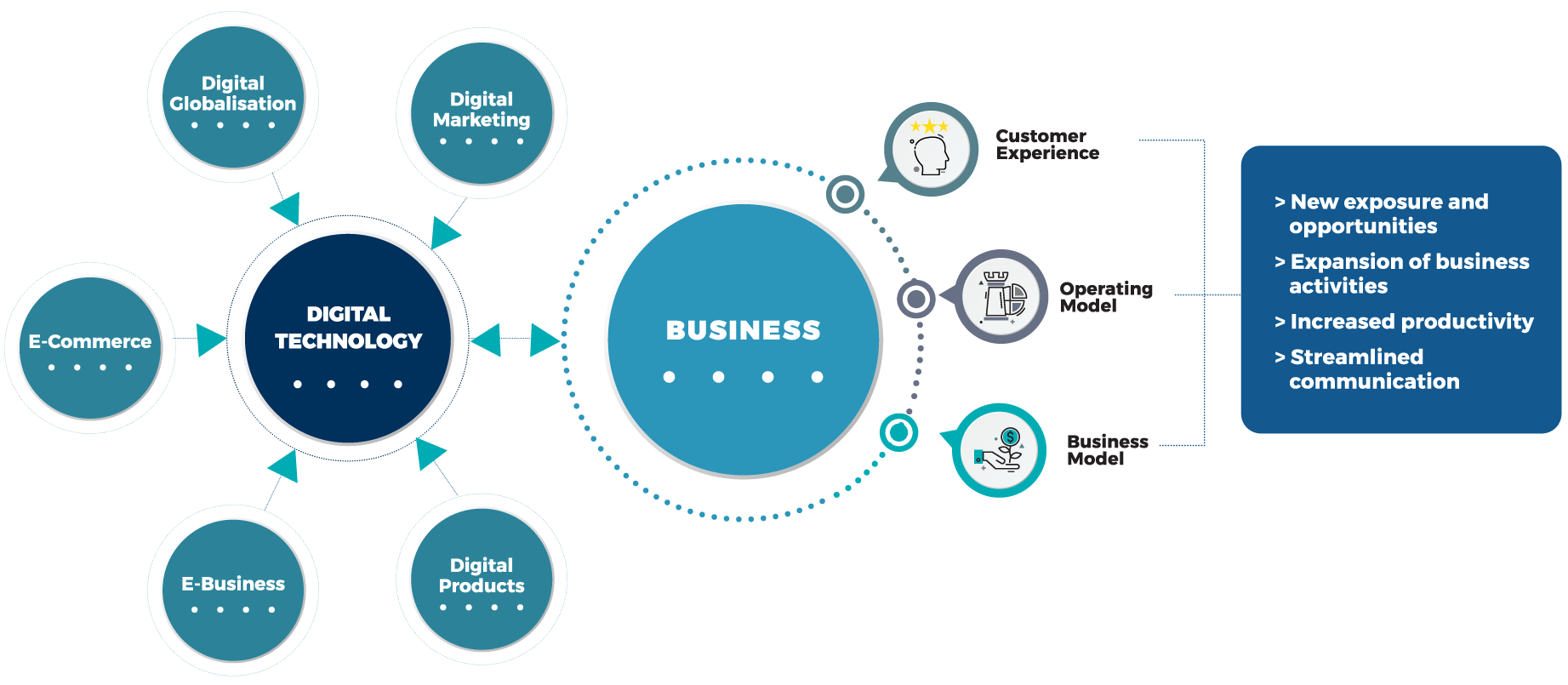
As the 4th Industrial Revolution (IR4.0) takes over the world, we are seeing an upward trend of the amalgamation of Digital Technology with Business. As businesses infuse digital technology within their operations, Digital Transformation elevates customer experience, and transforms business models and operating models within the organisation.
“Every Business is Becoming a Technology Business”
- Manju Bansal - Digitalist Magazine - 2018
"By 2025, the total number of digital skills required by workers to perform their jobs is projected to increase over 6 times – from one billion skills today to 6.8 billion skills."
- APAC Digital Skills Index - 2020
"As digital technologies become more prevalent, the digital economy will become the foundation of the modern economy. Accelerating the digital economy is no longer an option but crucial for Malaysia.”
- Malaysia Digital Economy Blueprint - 2021
“The digital economy is expected to continue its significant contribution to the country this year, based on an estimated 19.1 per cent contribution to the GDP in 2019 by the Department of Statistics Malaysia, following a forecast of 6.7 per cent economic growth for 2021 by the World Bank. With the launch of MyDIGITAL, the expected contributions from the digital economy towards the GDP is an estimated 22.6 per cent by 2025.”
- Malaysia Digital Economy Corporation (MDEC) - 2021
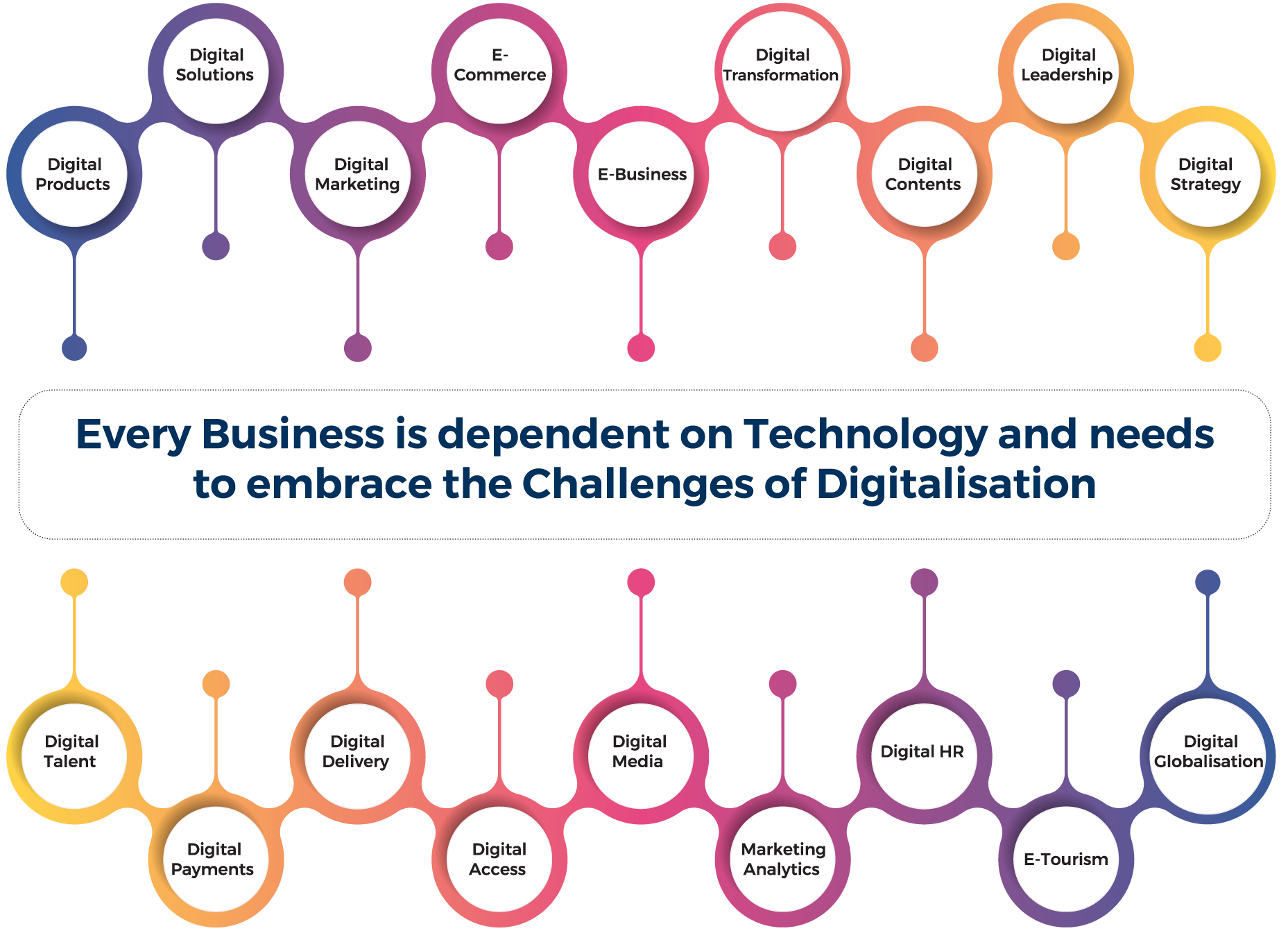
For businesses to remain resilient and competitive, they need to innovate, adopt Digital Products, Digital Solutions, have a Digital Growth Strategy, use technology for expansion and growth, as well as equip their workforce with the necessary skill sets to embrace widespread transformation and digital revolution in this Digital Age. The role of “Technology in Business” is vital and technology has challenged and changed every aspect of the way businesses operate at a fast pace. Rapid globalisation has been possible because of technology. Anyone can now do business anywhere in the world with use of high-speed internet, connectivity and presence of well-connected social media. Technology has boosted the development of E-Business, E-Commerce & Digital Marketing and it has brought new dynamics to the globalisation of businesses.

Business, Management, Marketing & Tourism
Collaborative Industrial Partners
Industry-academia collaboration is a strategic necessity to ensure the quality and relevance of our programmes. Through our Industry-Academia Collaboration (IAC) model, we design programmes in collaboration with inputs from the industry, that are also aligned with the government’s initiatives to address the shortage of skilled talents. Over the years, APU has established collaborations with key industry players worldwide; we have been delivering highly-relevant programmes that help us develop skilled and professional graduates for the workforce.
Facilities at APU
The APU Centre Point & Atrium serves as a melting pot of cultures from all over the world. Here, cultural activities are organised regularly at the campus, fostering long-lasting intercultural relationships among APU students, who come from over 130 countries.
Ready, Set, Go.
Whether you are locals or traveling here, we have the options for you to pursue your dreams.
RM32,400
Year 1
RM33,400
Year 2
RM34,600
Year 3
RM100,400
Total for Malaysian
RM34,900
(USD9,185)
Year 1
RM36,100
(USD9,500)
Year 2
RM37,500
(USD9,870)
Year 3
RM108,500
(USD28,555)
Total for International
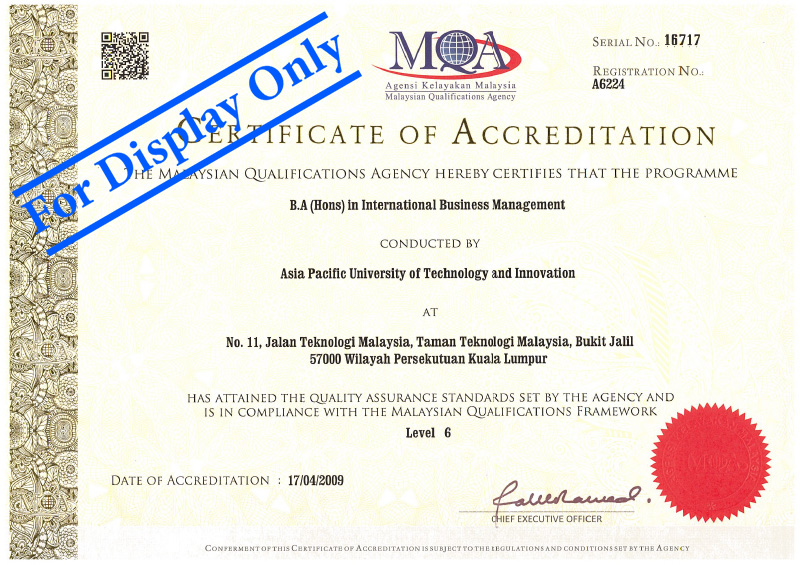
Programme code : (R3/0414/6/0088)(08/30)(A6224)
All information is correct at the time of publication, but is subject to change in the interest of continuing improvement.
Note : All fees are payable in Ringgit Malaysia (RM). Any USD amounts indicated by APU are for reference only and are non-binding. The final amount payable is the RM amount stated in the official invoice, and the University will not entertain any claims arising from foreign exchange fluctuations.

Open Day
Learn More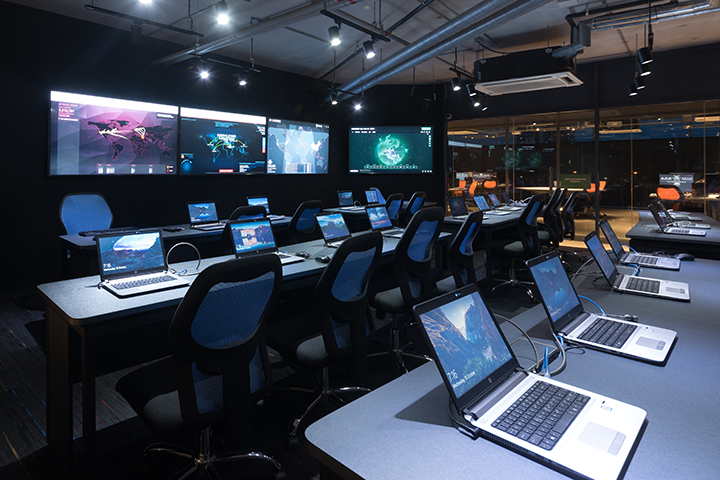
Campus Facilities
Learn MoreEnglish Language Study
Korean Language
APLC TESOL Programme
Want to know more ?
Let’s Connect