Debutant team Outlier Behaviour from APU, comprising Raif Izudin Rasulluddin, Muhammad Afi Danial Mazrul Afendi, Zetty Adleena Zul Azrin, and Nur Aleeya Adriana Suhaimi, clinched second place out of 400 participants at UNITEN’s Hackspire Lumina 2026 with De-Influence AI, an anti-impulse shopping assistant that analyses Shopee and TikTok Shop links in 2.5 seconds using Malay and Manglish NLP defect detection and trend-decay modelling to predict fast-fashion buyer regret.
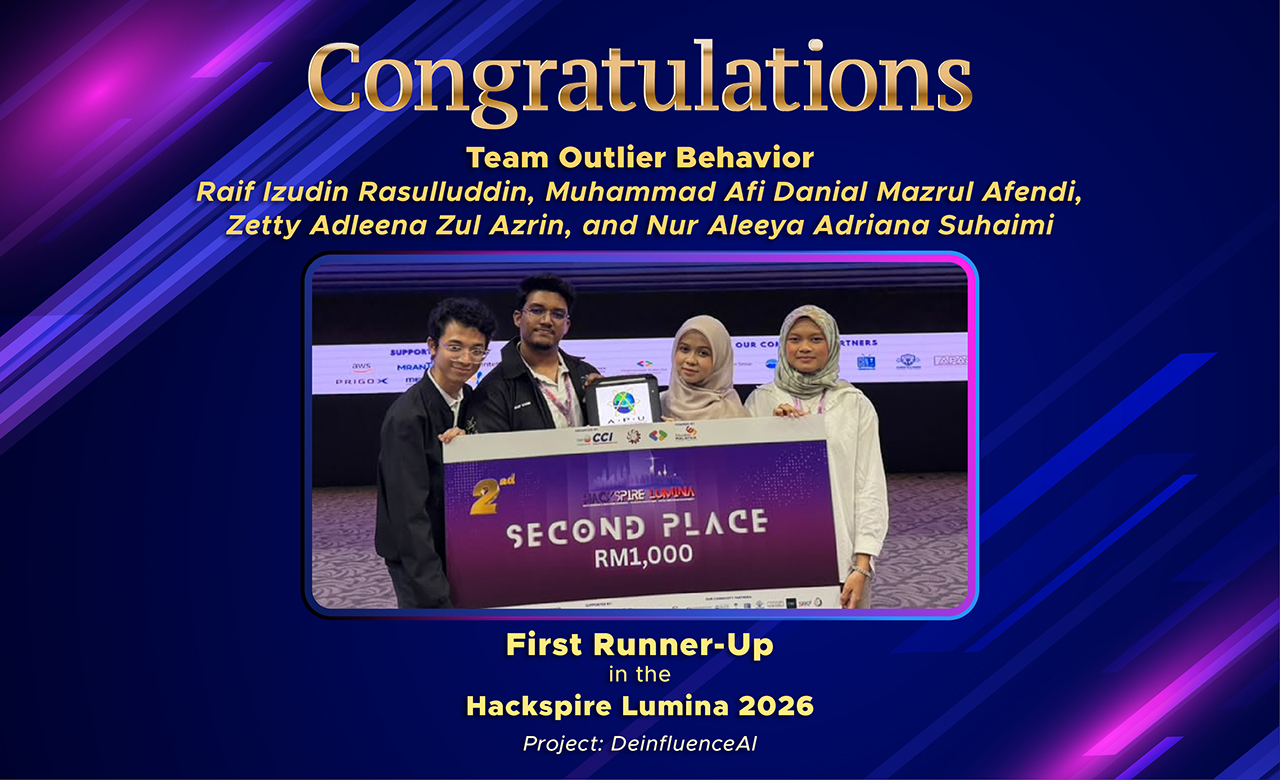
Despite entering their very first hackathon, Asia Pacific University of Technology & Innovation’s (APU) team Outlier Behaviour rose above fierce competition to secure second place at Hackspire Lumina 2026, held at Dewan Seri Sarjana, Universiti Tenaga Nasional (UNITEN).
Represented by Data Analytics students Raif Izudin Rasulluddin, Muhammad Afi Danial Mazrul Afendi, Zetty Adleena Zul Azrin, and Nur Aleeya Adriana Suhaimi, the team proved their mettle in a gruelling 72-hour data-driven showdown.
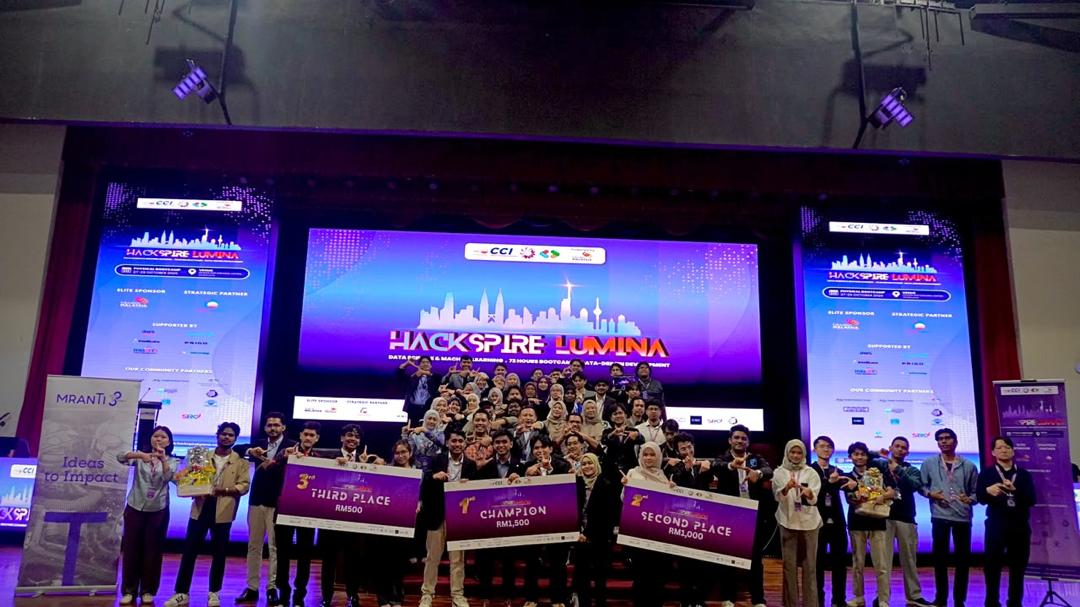
Organised by CCI UNITEN, CLICQ, and Google Developer Groups on Campus, and powered by Education Malaysia Global Services (EMGS), Hackspire Lumina drew 400 top-tier tech undergraduates and postgraduates.
The event took participants through an intensive bootcamp-to-hackathon journey consisting of two online sessions before culminating in the physical finale.
Guided by industry mentors and evaluated by a panel of corporate partners, teams raced against the clock to solve complex challenges across five specialised domains: Predictive Infrastructure & Energy Analytics; Smart Mobility & Citizen-Centric AI; E-Commerce & Consumer Intelligence; Intelligent Transit & Urban Mobility; and Global Edu-Tech & Talent Ecosystems.
Competing under Track 3: E-Commerce & Consumer Intelligence, team Outlier Behaviour captivated the judges with De-Influence AI: The Micro-Trend Lifespan & Fast-Fashion Regret Predictor.
Designed as an anti-impulse smart shopping assistant for Gen Z and university students aged 18 to 26, the platform intercepts checkout decisions on social commerce giants such as TikTok Shop and Shopee.
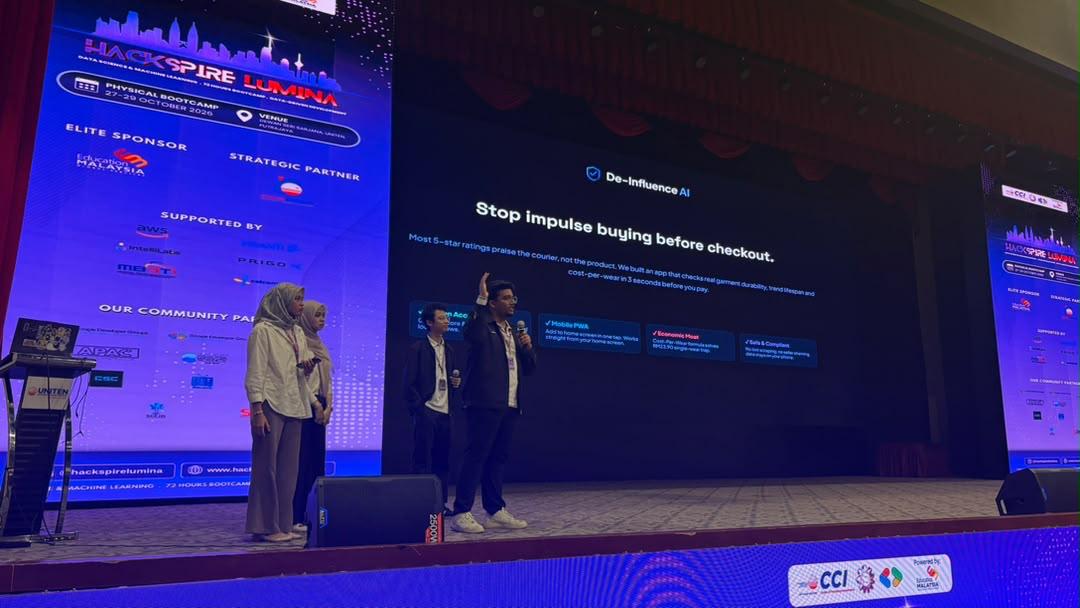
By curbing impulse spending on low-quality viral apparel, the solution safeguards student wallets while tackling a pressing environmental issue: the roughly 430,000 tonnes of textile waste sent to Malaysian landfills annually.
The team engineered De-Influence AI to combat algorithm-driven ‘doomspending’, where fake flash-sale markdowns and inflated five-star ratings — often praising fast courier riders (‘Abang posmen laju’) rather than actual garment quality — leave over half of fast-fashion buyers regretting items that tear or shrink after only a few wears.
By pasting a Shopee or TikTok Shop product link into the web application prior to purchase, users receive a Product Longevity Score (0–100), a Regret Probability Index, and a True Cost-Per-Wear estimate within approximately 2.5 seconds.
This rapid evaluation is driven by three core analytical engines working in tandem. First, a Localised NLP Regret Extractor filters out irrelevant shipping feedback to detect genuine fabric defects written in Malay and Manglish slang, flagging phrases such as ‘kain nipis’ (thin fabric), ‘koyak lepas basuh’ (torn after washing), and ‘tak berbaloi’ (not worth it).
Second, a Hype-Cycle Decay Forecaster applies Gompertz decay modelling to search velocity data to predict how many days a viral micro-trend has left before falling out of style.
Finally, a TrueCost Simulator calculates realistic cost-per-wear by weighing predicted garment durability against the retail listing price.
Under the hood, the architecture combines a Streamlit frontend, an AI Agent link validator, and n8n workflow automation running Python and JavaScript scoring nodes, paired with an executive Power BI dashboard tracking macro fake-discount trends and total money saved.
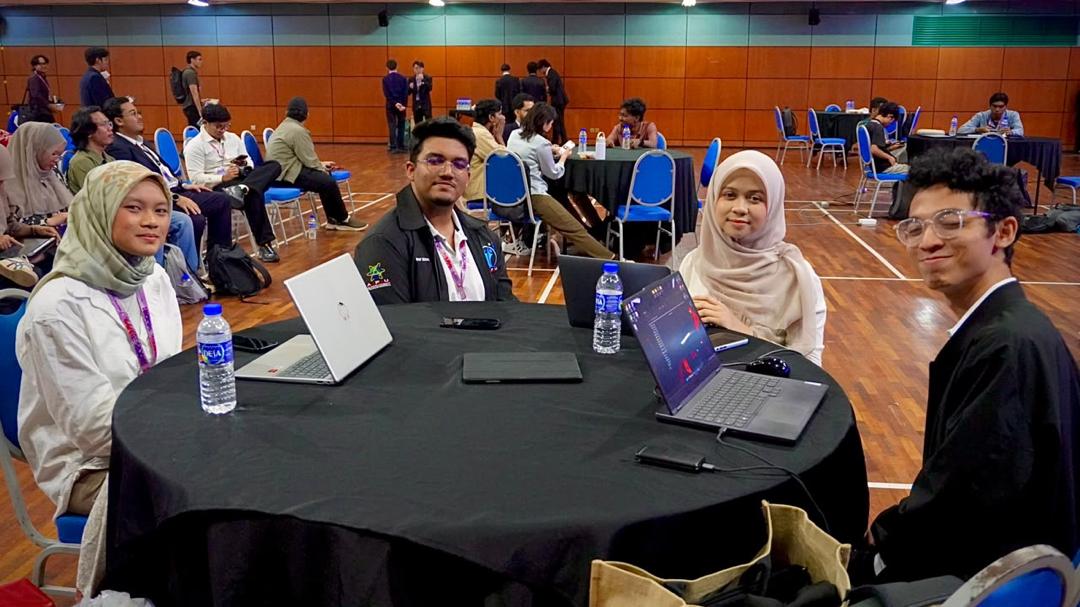
Looking ahead, the team plans to expand the prototype into a Chrome browser extension that automatically flags high-regret items directly on Shopee and TikTok Shop checkout pages while recommending sustainable wardrobe alternatives.
Speaking on behalf of the team, Raif Izudin Rasulluddin reflected on the intensity of the 72-hour sprint and the real-world local focus behind their project.
“Walking into our first-ever hackathon against 400 brilliant minds was intimidating, especially with the clock ticking down over 72 hours,” said Raif.
“We wanted to build something genuinely relevant to Malaysian students, which is why integrating Malay and Manglish defect detection into De-Influence AI became our core focus. Online hype does not always look like a formal advertisement; it happens in viral micro-trends and everyday slang across social commerce.”
Raif also credited the team’s chemistry and their data analytics training at APU for helping them transform a raw concept into a working prototype under extreme time pressure.
“None of us expected to place, let alone walk away with Second Place on our debut,” he added.
“There were moments late at night when debugging the scoring nodes and decay models felt endless, but everyone leaned into their strengths. This win proved to us that with the right grit and teamwork, APU students can stand toe-to-toe with the best innovators in the country.”
While Hackspire Lumina 2026 drew to a close, team Outlier Behaviour’s breakthrough signalled an exciting beginning for their future in technology and innovation.
News & Happening
Download e-Brochures
Intake Calendar
Want to know more ?
Let’s Connect