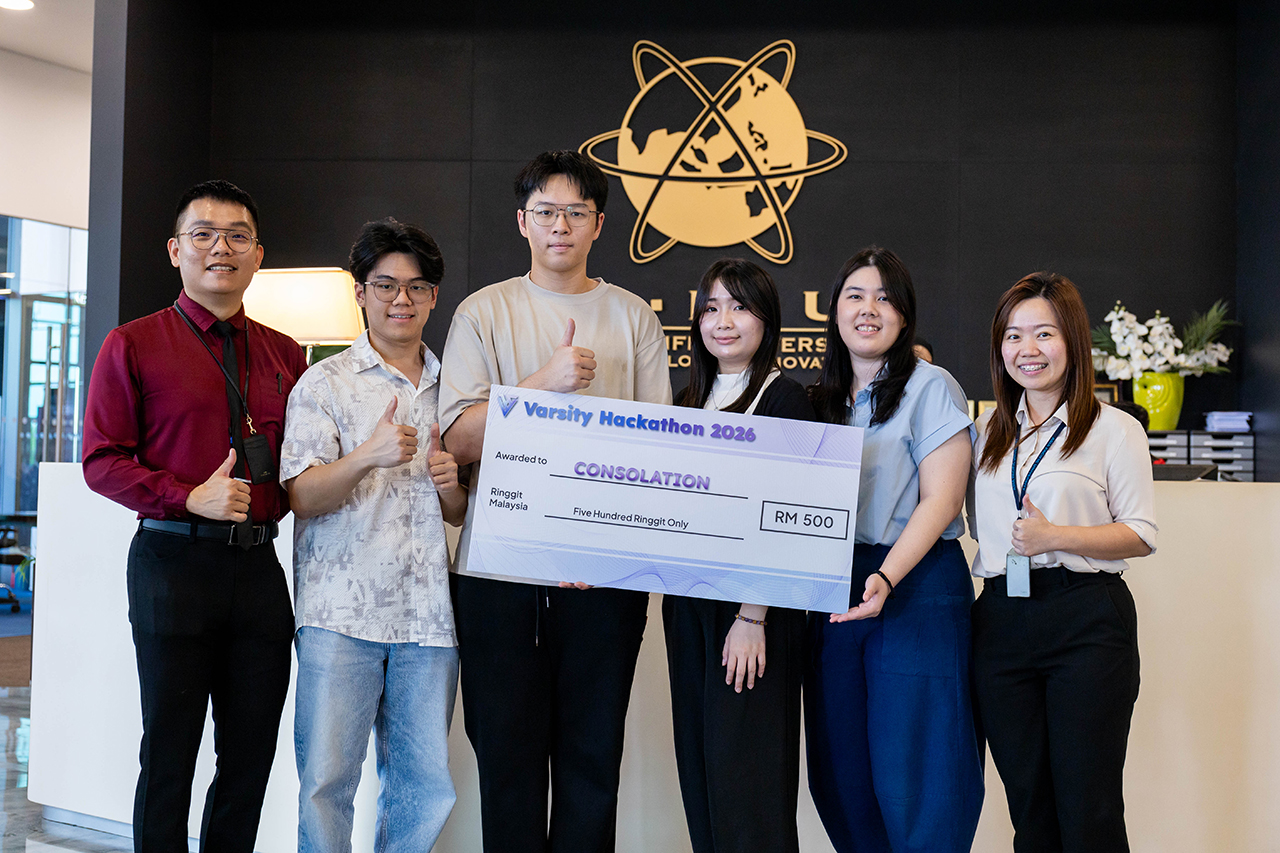
A team of talented Computer Engineering students from the Asia Pacific University of Technology & Innovation (APU) has earned national recognition after securing a remarkable double achievement at VHack 2026 with an innovation designed to support disaster response efforts when communication systems fail.
Competing under the name Team SwarmguardHQ, students Kok Jia Yin, Cindy Pua Kah Qi, Mervin Ooi Zhian Yang, and Chin Kai Jack impressed judges with “SIREN—Swarm Intelligence for Rescue and Emergency Navigation”, a fully offline AI rescue drone orchestration system built to operate in disaster-stricken environments without internet connectivity.
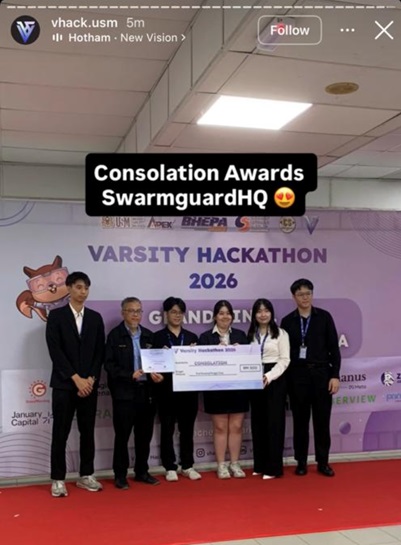
At the finals of VHack 2026, held on 25 April 2026 at Universiti Sains Malaysia (USM), the team walked away with both the Best Presentation Award and a Consolation Prize of RM500. Organised by the USM Computer Science Society, VHack is widely recognised as one of Malaysia’s most competitive university hackathons, attracting bright young innovators from across the country.
Addressing a Critical Gap in Disaster Response
What made SIREN particularly compelling was its strong humanitarian focus and immediate real-world relevance.
The team developed the system to address a major challenge often faced during floods, earthquakes, and other catastrophic emergencies that caused the collapse of communication infrastructure. In many disaster situations, conventional AI systems become ineffective because they rely heavily on internet connectivity and cloud-based operations.
SIREN was designed to overcome this limitation.
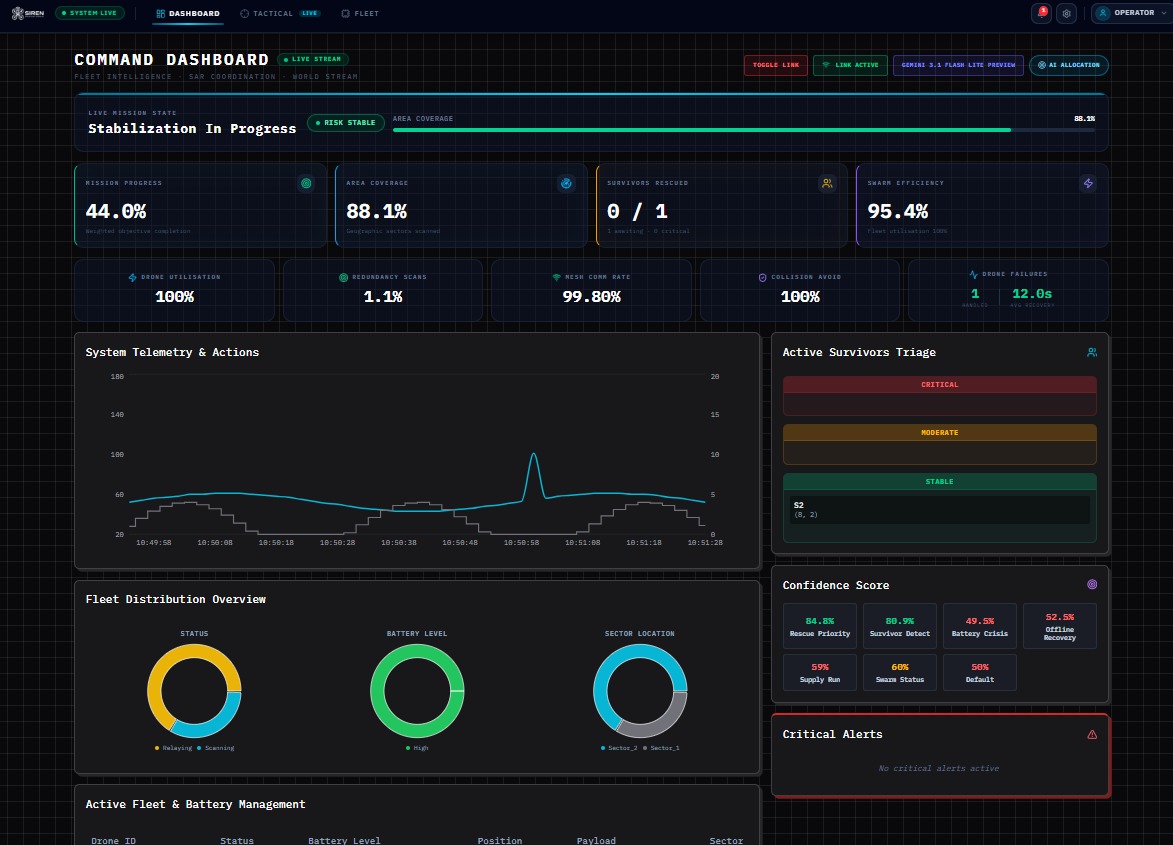
Operating entirely offline, the system enables a fleet of rescue drones to continue coordinating missions autonomously, even in environments where communication networks have completely failed. Powered by an on-device large language model (LLM) and a LangGraph-based AI agent, SIREN is capable of intelligent reasoning and autonomous decision-making without depending on external servers or cloud access.
The AI system communicates with rescue drones through 21 standardised Model Context Protocol (MCP) tools, allowing the drones to carry out mission-critical operations such as search-and-rescue scanning, battery management, emergency supply delivery, and self-healing mesh network recovery.
According to team member Kok Jia Yin, the idea behind SIREN emerged from a desire to ensure that technology remains useful precisely when humanity needs it most.
“When disasters strike, internet-dependent systems often fail at the worst possible moment. SIREN was created to bridge that gap by enabling rescue drones to continue searching, coordinating, and delivering aid independently, even when conventional systems go dark,” said Jia Yin.
Combining AI, Transparency, and Human Oversight
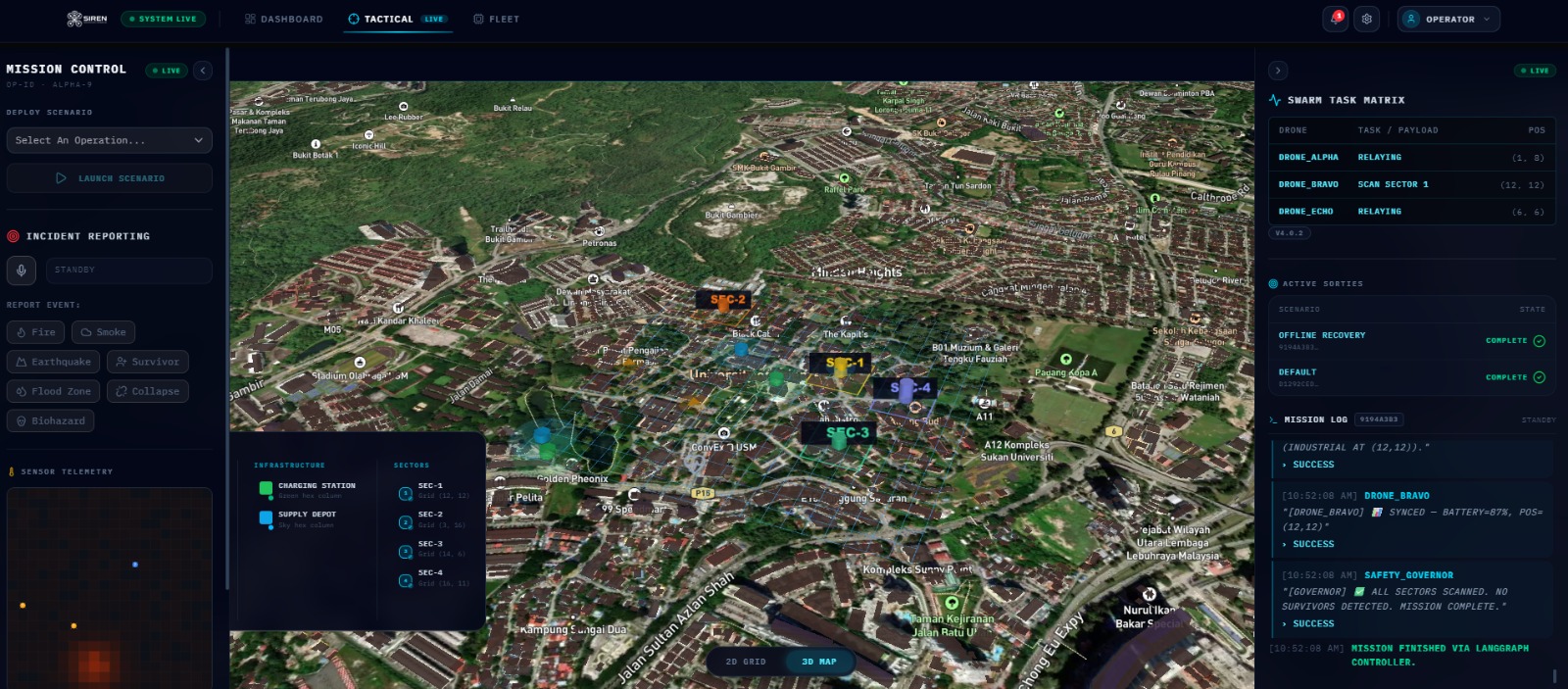
Beyond its technical sophistication, SIREN also stood out for its emphasis on transparency and human oversight.
One of the system’s most distinctive features is a live dashboard built on Next.js 15, which streams the AI’s real-time Chain-of-Thought reasoning to field commanders. This enables rescue personnel to monitor and understand how the AI makes decisions during autonomous operations — an increasingly important factor in responsible AI deployment.
What truly differentiated SIREN from other competing solutions was its unique integration of multiple advanced capabilities into a single ecosystem. These included full offline functionality, on-device LLM reasoning, MCP compliance, self-healing swarm coordination, and an explainable audit trail — features rarely combined within a disaster-response system.
Mentorship and Collaborative Learning
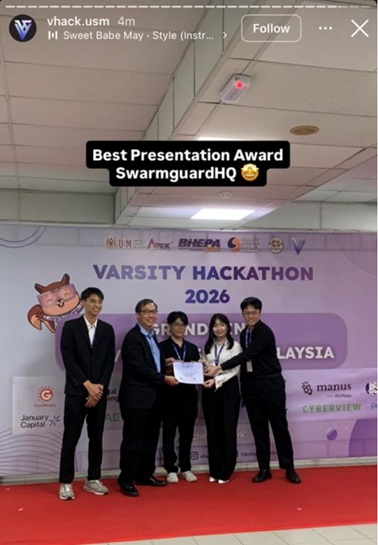
The team’s achievement was guided by strong mentorship and interdisciplinary collaboration.
Team SwarmguardHQ was mentored by Ms Tan Li June, Lecturer from APU’s School of Computing (SoC), alongside Asst Prof Ir EUR ING Ts Dr Lau Chee Yong from the School of Engineering (SoE), who also leads the Visionary AI Studio at APU.
Their guidance helped the students refine not only the technical dimensions of the project, but also their ability to communicate complex ideas clearly and meaningfully.
Empowering Students to Create Technology for Good
Prof Ir EUR ING Dr Vinesh Thiruchelvam, Chief Innovation & Enterprise Officer (CIEO) and Chief Sustainability Officer (CSO) of APU, congratulated the team on their outstanding accomplishment.
“This achievement reflects the kind of purpose-driven innovation we strive to cultivate at APU. SIREN demonstrates how young talent can apply advanced technology to solve meaningful humanitarian challenges while creating real societal impact,” he said.
The success of Team SwarmguardHQ at VHack 2026 further reinforces APU’s standing as a leading technology and innovation institution in Malaysia, where students are empowered to combine creativity, technical excellence, and social responsibility to address complex real-world challenges.
More importantly, it highlights how the next generation of innovators is increasingly driven not only by technological advancement, but by the desire to create solutions that can genuinely improve lives when it matters most.
News & Happening
Download e-Brochures
Intake Calendar
Want to know more ?
Let’s Connect